Since this is a request for creative writing (an article) and a specific technical output (a JSON prompt) based on administrative text, and does not require current factual or statistical information from the internet, no tool call is necessary for the main article content.
Article Structure:
- Introduction (The Vision): Contextualize the scheme within Goa’s commitment to social welfare and healthcare.
- The Objective & Target Groups: Detailed breakdown of who the scheme is for (SC, OBC, Minority, Disabled) and the role of the Directorate of Social Welfare.
- Eligibility and Course Coverage (The Pathway): Deep dive into the specific courses covered (Certificate, Diploma, Degree in Nursing, Health Worker) and essential criteria (Goan Origin, Regular Student status).
- Financial Assistance Explained (The Support): Detailed section on the financial benefits: Course Fees, Maintenance Allowance (Day Scholars vs. Hostellers, SC vs. Others), and the one-time grant for books/uniforms.
- The Fine Print (Important Conditions): Examination of key restrictions (income cap, non-duplication of scholarships, internship/housemanship exclusion).
- The Application Process (How to Apply): Step-by-step breakdown of the required documentation.
- Conclusion (Impact and Future): Summarizing the scheme’s potential impact on healthcare human resources in Goa.
🇮🇳 Empowering Future Caregivers: A Detailed Look at Goa’s Social Welfare Scholarship for Health and Nursing Courses
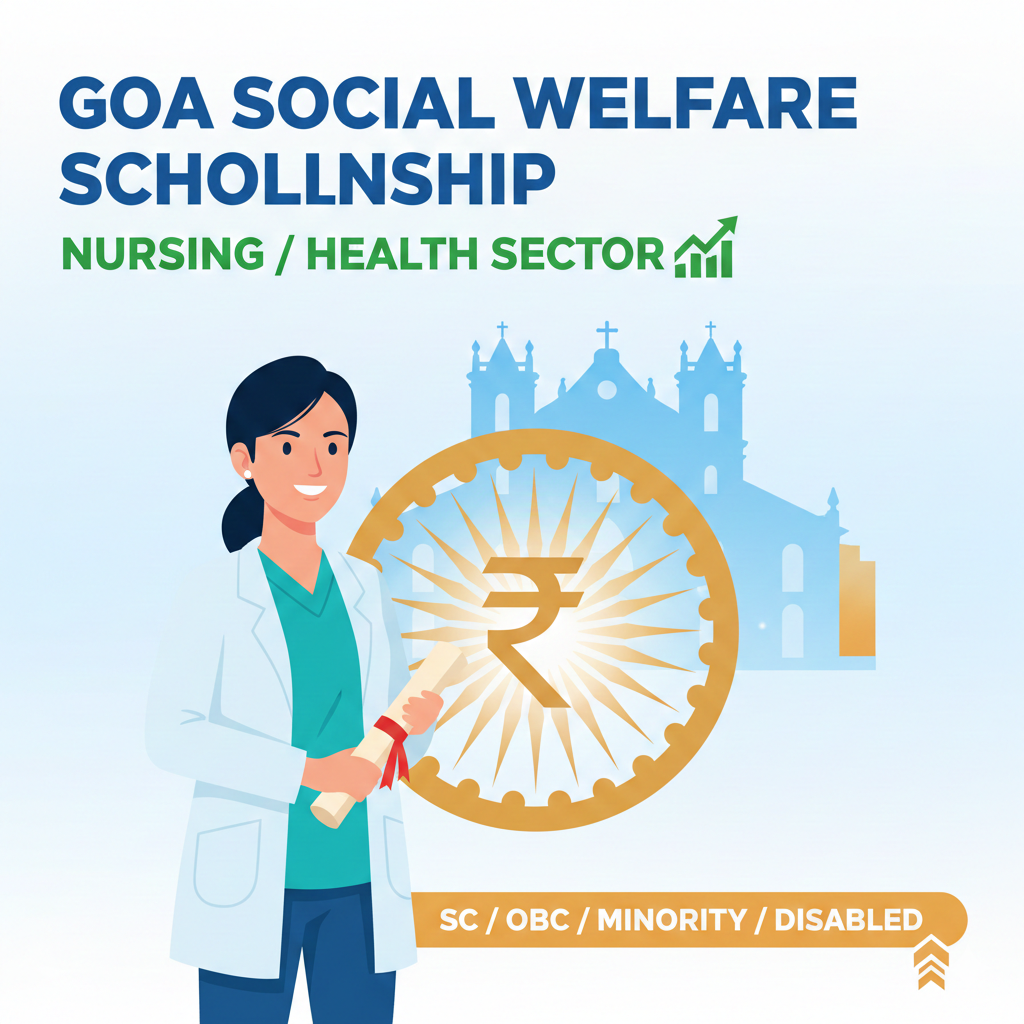
The path to a fulfilling career in healthcare is often fraught with financial hurdles, a challenge amplified for students from marginalized and vulnerable communities. Recognizing the dual need to support social equity and bolster its human resources in the critical health sector, the Government of Goa, through its Directorate of Social Welfare, has instituted a vital scholarship scheme. This initiative is explicitly designed to empower students belonging to Scheduled Castes (SC), Other Backward Classes (OBC), Minority communities, and Persons with Disabilities (Disabled), enabling them to pursue essential nursing and health worker courses within India.
This comprehensive article delves into the specifics of this Goan scholarship, dissecting its objectives, eligibility criteria, and the substantial financial assistance it offers, ultimately highlighting its potential impact on the state’s social and healthcare landscape.
🌟 The Objective: Bridging Equity and Healthcare Needs
The core objective of this scholarship is twofold: to promote inclusive education by dismantling financial barriers for underprivileged and vulnerable groups, and to cultivate a robust cadre of skilled healthcare professionals vital for public service. By focusing on courses that directly contribute to the healthcare system—specifically those available for study in India only—the scheme ensures that its investment directly translates into local capacity building. The scholarship is meticulously channeled through the Directorate of Social Welfare, underscoring its foundation in the state’s commitment to welfare programs.
🎓 The Pathway: Eligible Courses and Enrollment Criteria
The scheme is specifically tailored to support professional development in key health-related fields. Eligibility is tied to enrollment in a few, clearly defined courses, ensuring the funds are directed toward high-value, high-demand areas.
Courses Covered:
The scholarship covers four distinct levels of qualification, all to be pursued from an institution recognized by the State/Central Government:
- (a) Certificate Course in Home Nursing: Requires a minimum duration of at least six months. This entry-level course provides fundamental skills necessary for immediate employment in assisted living or home care settings.
- (b) Diploma in Home Nursing: Requires a duration of one year or more, offering a deeper, more specialized level of training than the certificate course.
- (c) Degree in Nursing (B.Sc. Nursing): The gold standard of basic professional nursing education, this course must be of three years’ duration.
- (d) Health Worker Course: Requires a duration of one year or more, focusing on community health and primary care roles which are crucial for grassroots healthcare delivery.
Essential Eligibility Gates:
While belonging to the target social groups is primary, several strict criteria ensure the integrity and local focus of the scheme:
- Residency and Origin: The applicant must be a regular student of Goan Origin. This ties the benefit directly to the state’s residents, ensuring local talent is developed.
- Income Cap: Crucially, the annual income of the parent or guardian from all sources must not exceed $Rs 1.50$ lakh ($Rs 150,000$). This ensures the assistance is targeted toward economically disadvantaged families.
- Non-Duplication Clause: A student receiving assistance under this scheme cannot simultaneously avail any other scholarship or stipend for the same course. This maximizes the reach of the scheme to different deserving individuals.
- No Stipend Period Support: The scholarship explicitly states that payment will not be made during periods of internship, housemanship, or practical training if the student is already in receipt of any remuneration, allowance, or stipend during that time. This prevents double-dipping and focuses the financial aid on the period of tuition and academic study.
💰 Assistance: A Multi-Tiered Financial Safety Net
The scholarship provides a robust, multi-tiered assistance structure covering course fees, monthly maintenance, and a one-time grant for essential supplies. This holistic approach ensures students can focus on their studies without the constant burden of financial stress.
1. Course Fees (Tuition Support):
The level of financial support for tuition is tiered based on the complexity and duration of the course:
| Course Type | Maximum Financial Assistance |
| Certificate Courses | $Rs. 3,500$ or actual fees, whichever is less. |
| Diploma Courses | $Rs. 5,000$ or actual fees, whichever is less. |
| Degree in Nursing | $Rs. 10,000$ or actual fees, whichever is less. |
| Health Worker Course | $Rs. 3,500$ or actual fees, whichever is less. |
The maximum quantum of $Rs. 10,000$ for a Degree in Nursing reflects the higher academic commitment required for this professional qualification.
2. Maintenance Allowance (Living Expenses):
To assist with daily living expenses, a monthly maintenance allowance is provided, with a higher rate dedicated to SC students—a reflection of the constitutional mandate to prioritize the advancement of Scheduled Castes. The allowance is further bifurcated based on the student’s living arrangements:
| Student Category | Day Scholars (p.m.) | Hostellers (p.m.) |
| S.C. Students | $Rs. 500/-$ | $Rs. 800/-$ |
| Other Eligible Groups (OBC, Minority, Disabled) | $Rs. 300/-$ | $Rs. 600/-$ |
The Hostellers’ allowance is substantially higher, acknowledging the increased cost of boarding and lodging away from home.
3. One-Time Additional Grant (Books, Uniform, Stationery):
A key feature of the scheme is the provision of a one-time additional amount to cover initial setup costs like books, uniforms, and stationery—items that often represent a significant upfront expense that can deter students from enrolling. This grant is also course-dependent:
| Course | One-Time Grant |
| Certificate Courses | $Rs. 1,000/-$ |
| Diploma Courses | $Rs. 2,000/-$ |
| Degree in Nursing | $Rs. 3,000/-$ |
| Health Worker Course | $Rs. 2,000/-$ |
The highest grant of $Rs. 3,000$ is reserved for Degree in Nursing students, reflecting the typically higher cost of textbooks and specialized supplies required for a three-year professional degree.
📝 The Application Blueprint: Documents Required
A streamlined and comprehensive application process is essential for the effective delivery of welfare schemes. Applicants must meticulously prepare and submit a full set of documents to the Directorate of Social Welfare. The list of required documentation serves to authenticate the applicant’s identity, social status, income level, residency, and course enrollment.
The following documents are mandatory:
- Identity & Application: Copy of Aadhar Card, one copy of the application in the prescribed form, and one passport-size photograph.
- Social Status: An attested copy of the Caste Certificate/Social Status Certificate (for SC, OBC, and Minority applicants).
- Academic Proof: One attested copy of all relevant certificates, diploma, degree, etc., in respect of all examinations passed.
- Financial Proof: An income certificate issued by the competent authority clearly showing the annual income of the parents/guardians from all sources (to verify the $Rs 1.50$ lakh cap).
- Residency Proof: Birth Certificate/proof of Goan Origin and a 15 years Domicile Certificate or Residence Certificate.
- Enrollment & Banking: The receipt of fees paid to the institution (in original) and a copy of the Bank Passbook for direct fund transfer.
The rigor in documentation is necessary to ensure that the subsidy reaches only the genuinely eligible and deserving students from the target groups.
🤝 Conclusion: Investing in Goa’s Future
The Scholarship Scheme offered by the Directorate of Social Welfare in Goa is a powerful example of an integrated approach to social equity and economic development. By specifically targeting students from SC, OBC, Minority, and Disabled groups for health and nursing education, the government is not only fulfilling its constitutional and moral obligations but is also strategically addressing the shortage of trained healthcare personnel.
The financial assistance—covering tuition, monthly maintenance, and essential supplies—is comprehensive, providing a necessary lifeline for students from low-income backgrounds. Ultimately, this scheme promises to create a more equitable educational landscape in Goa, fostering a new generation of skilled, compassionate healthcare professionals ready to serve their local communities. The successful implementation and continued outreach of this scholarship will be instrumental in improving both the social indicators and the quality of public health services across the state.