India’s economic engine is powered significantly by its vast, yet largely unprotected, unorganised workforce. This critical segment, comprising street vendors, rickshaw pullers, agricultural labourers, and domestic workers, contributes immensely to the nation’s Gross Domestic Product (GDP) but often faces a precarious existence, lacking the formal social security nets enjoyed by the organised sector. Addressing this profound vulnerability, the Government of India launched the Pradhan Mantri Shram Yogi Maan-Dhan Yojana (PM-SYM), a landmark voluntary and contributory pension scheme aimed at providing Old Age Protection and ensuring a life of dignity post-retirement.
Launched by the Ministry of Labour and Employment in February 2019, PM-SYM is more than a welfare measure; it is a structural mechanism to integrate an estimated 42 crore unorganised workers into a formal social security system. This article delves deep into the architecture of the PM-SYM, examining its contribution model, eligibility criteria, the life-altering benefits it promises, and its overall significance in India’s social security landscape.
🎯 The Architecture: A Shared Responsibility for Retirement
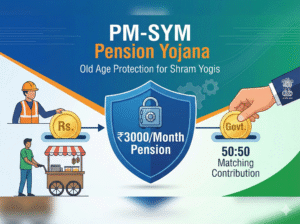
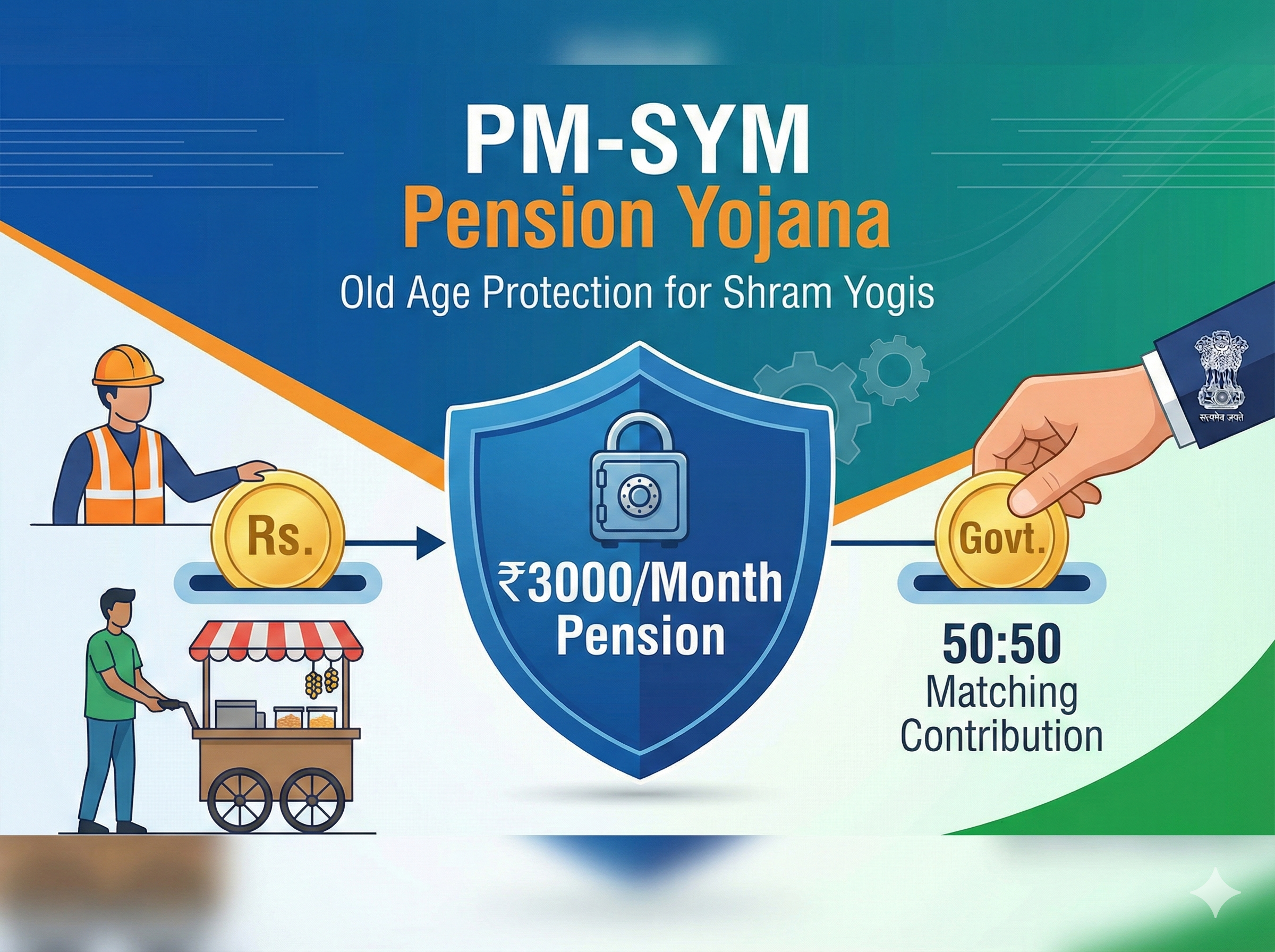
The foundational principle of PM-SYM is one of joint responsibility, commonly known as a 50:50 contributory basis. The scheme ensures that the central government matches every single rupee contributed by the beneficiary, doubling the investment towards their retirement corpus.
Contribution Mechanism:
The scheme is designed to be affordable and flexible, recognizing the often sporadic income patterns of unorganised workers.
- Voluntary and Contributory: Participation is entirely voluntary, but beneficiaries must contribute monthly from their entry age until they turn 60 years old.
- Age-Based Contribution: The required monthly contribution is low and directly dependent on the beneficiary’s entry age, ensuring the scheme is accessible to younger workers who benefit from a lower payment schedule.
- The monthly contribution ranges from $Rs. 55/-$ to $Rs. 200/-$. For example, a worker enrolling at 18 years contributes $Rs. 55/-$, while a worker enrolling at the maximum entry age of 40 contributes $Rs. 200/-$.
- Government Matching: The Central Government pays an equal matching contribution into the beneficiary’s pension account every month. This unique feature dramatically reduces the burden on the worker while ensuring rapid accumulation of the pension corpus.
- Auto-Debit Facility: Contributions are facilitated through an ‘auto-debit’ facility from the worker’s Savings Bank Account or Jan Dhan Account, ensuring regularity and convenience.
This system guarantees that the Central Government provides substantial financial backing for every worker who commits to planning for their old age, making the scheme one of the most beneficial social security options for the target group.
🔑 Eligibility: Defining the Shram Yogi
PM-SYM is meticulously targeted to reach those most in need of a financial safety net, setting clear boundaries to prevent misuse and overlap with existing schemes.
Essential Eligibility Criteria:
- Citizenship: The beneficiary must be an Indian Citizen.
- Target Group (Unorganised Workers): The scheme is exclusively for Unorganised Workers (UW), defined broadly to include occupations such as: street vendors, rickshaw/auto-wheelers, rag pickers, construction site workers, agricultural labourers, domestic workers, mid-day meal workers, handloom workers, leather workers, carpenters, and fishermen, among many others.
- Age and Income:
- Age Group: Must be between 18 and 40 years at the time of entry.
- Income Limit: Monthly income must be below $Rs. 15,000/-$.
- Exclusionary Clauses: To avoid duplication and target the truly unorganised, the worker must NOT be a member of the Employees’ Provident Fund Organisation (EPFO), Employees’ State Insurance Corporation (ESIC), or the National Pension System (NPS) (Government funded). Additionally, the worker should NOT be an income taxpayer.
These criteria ensure that the scheme’s benefits are precisely channeled to young and middle-aged workers in the informal sector who lack any formal retirement protection.
💖 The Assured Benefit: A Guarantee of Old Age Dignity
The most compelling feature of the PM-SYM is the certainty of its payout, providing a guaranteed income source during the twilight years.
- Assured Monthly Pension: After attaining the age of 60 years, beneficiaries are entitled to receive a minimum assured monthly pension of $Rs. 3,000/-$ for their lifetime. This fixed monthly sum provides basic financial security, mitigating poverty risk in old age.
- Family Pension (Spouse Protection): The scheme includes a critical provision for the spouse:
- On the death of the beneficiary (after retirement), the spouse is eligible for $50\%$ of the monthly pension (i.e., $Rs. 1,500/-$) as a family pension. This ensures continued financial support for the surviving partner.
- Enhanced Family Security: If both the husband and wife (both being unorganised workers and meeting the eligibility criteria) join the scheme separately, they are eligible to receive a joint monthly pension of $Rs. 6,000/-$ ($Rs. 3,000/-$ each) after attaining 60 years. This effectively secures the financial future of the entire household.
🌐 Implementation and Outreach: Bridging the Digital Divide
The sheer scale of the unorganised sector necessitates a robust and accessible implementation mechanism. The scheme is administered by the Ministry of Labour and Employment and is implemented collaboratively through the Life Insurance Corporation of India (LIC), which acts as the Pension Fund Manager, and the network of Common Service Centres (CSCs).
- Enrolment: Registration is primarily facilitated through the nearest Common Service Centres (CSCs) across the country. Workers need to furnish their Aadhaar Card, Mobile Number, and Savings Bank Account/Jan Dhan account details (with IFSC) for enrollment, which is based on self-certification.
- Facilitation: Offices of LIC, EPFO/ESIC, and all central and state Labour offices act as facilitation centres, setting up help desks to guide unorganised workers through the enrolment process, addressing the issue of low digital literacy.
- Flexibility and Withdrawal: Recognizing the volatile nature of the unorganised sector’s employment, the scheme includes flexible exit provisions:
- If a beneficiary exits the scheme after 10 years but before 60 years of age, they receive their contribution along with the interest earned by the fund (or the savings bank interest rate, whichever is higher). This avoids penalizing workers who face emergencies.
📈 Challenges and Significance
Despite its excellent design, the PM-SYM, like all large-scale CCT schemes, faces implementation hurdles, including low enrollment rates compared to the massive target population, lack of awareness, and the difficulty faced by daily-wage earners in making regular contributions.
However, its significance cannot be overstated:
- Recognition and Dignity: The scheme formally recognizes the economic contribution of unorganised workers and extends a critical right to old-age security, bestowing dignity.
- Poverty Alleviation: By guaranteeing a minimum income post-60, PM-SYM directly targets chronic poverty in old age, which is a major social issue in India.
- Financial Inclusion: It encourages the target group to maintain formal bank accounts and commit to long-term savings, driving deeper financial inclusion.
The Pradhan Mantri Shram Yogi Maan-Dhan Yojana stands as a cornerstone of India’s social security architecture. It is a powerful example of a participatory scheme where the government meets the worker halfway, ensuring that the millions who build the nation’s infrastructure and services are themselves protected from economic vulnerability in their sunset years. Its continued success and expansion are crucial to realizing the vision of universal social security for every Indian worker.