In the landscape of social welfare and public health initiatives, the Financial Incentives to mothers who deliver a Girl Child (MAMTA) scheme, launched by the Government of Goa, stands out as a direct and strategic intervention. MAMTA is not just a financial aid program; it is a powerful policy tool specifically designed to address one of the most critical demographic challenges facing the state and the nation: the unfavorable female Child Sex Ratio.
By providing financial incentives linked to crucial health and educational milestones, the scheme transforms the perception of the girl child from a perceived liability into a valued asset, thereby encouraging families to welcome and invest in their daughters.
🎯 The Core Objective: Rebalancing the Scales of Gender
The primary and most crucial objective of the MAMTA scheme is to improve the female Child Sex ratio in the State. This is a direct acknowledgement of the sociological and economic factors that lead to gender-selective practices and neglect of the girl child. By offering a structured financial benefit that begins immediately upon birth and extends through major life stages, the government aims to create a powerful counter-incentive against gender bias.
The scheme strategically leverages financial security to influence familial decisions, ensuring that the birth of a girl child is celebrated and protected, thereby improving her survival rate and long-term well-being.
👪 Eligibility and Residency Requirements
The scheme’s criteria are designed to ensure broad participation while maintaining a strong linkage to the residents of Goa, thereby ensuring that state resources are directed to its constituents.
Criteria for Eligibility:
- Childbirth: The incentive is applicable to all mothers who deliver a live girl Child in a registered medical institution. This condition is vital as it promotes institutional deliveries, which significantly improves maternal and infant health outcomes.
- Delivery Limit: The benefit is capped at a maximum of two deliveries, focusing the incentive on families aiming for a smaller, healthier family size, which aligns with national demographic goals.
- Socio-Economic Inclusivity: Notably, the scheme is available to all, irrespective of their social / economical status. Unlike many other welfare programs that are income-restricted, MAMTA’s universal accessibility underscores the government’s stance that improving the Child Sex Ratio is a societal issue requiring widespread behavioral change, not just poverty alleviation.
- Goan Residency Link: To qualify, the mother must be a resident of Goa for at least three years or must be married to a resident of Goa (with supporting documentation). This ensures that the scheme’s benefits are dedicated to the state’s long-term population.
Application Process:
The application process is simple and localized, utilizing the existing social welfare infrastructure:
- The eligible mother must apply to the Child Development Project Officer (CDPO) through the local Anganwadi Centre.
- The application, submitted in the prescribed form, must be accompanied by a copy of the Birth report/Birth Certificate.
- Crucially, the application must be submitted within 45 days of the delivery of the girl child to secure the first installment.
- All benefits are directly credited to the declared Bank Account (Direct Benefit Transfer or DBT), ensuring efficiency and transparency.
💰 The Financial Structure: A Five-Stage Investment
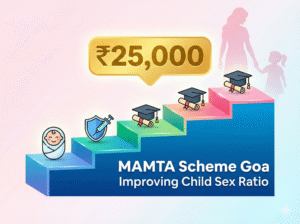
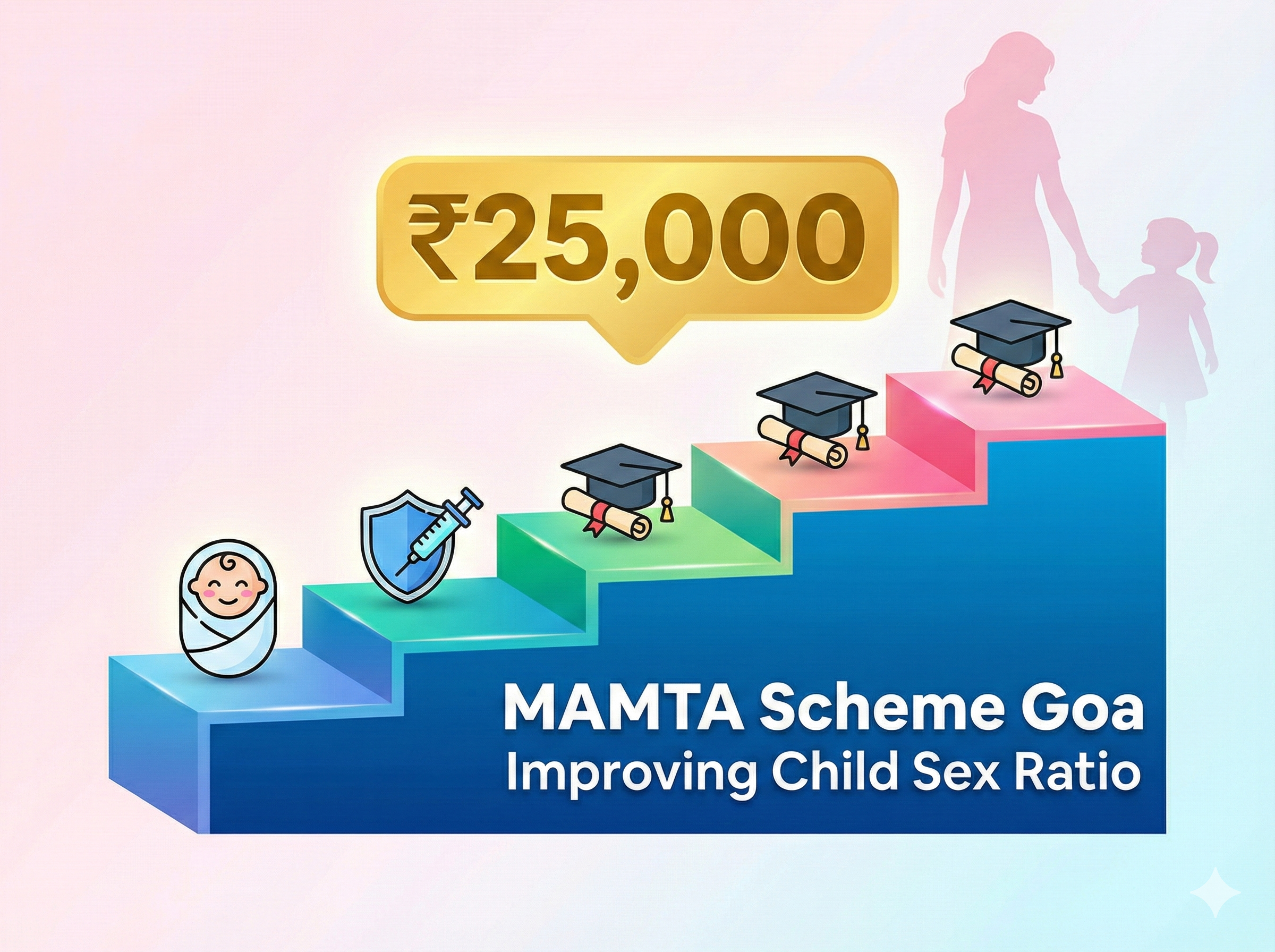
The MAMTA scheme promises a total financial incentive of Rs. 25,000/- (Rupees Twenty Five Thousand Only). The brilliance of the scheme lies in its disbursal linked to 5 stages, with each installment of Rs. 5,000/- strategically tied to critical checkpoints in the girl’s life, from immediate healthcare to advanced education.
This staggered payment mechanism ensures that the incentive money is not spent immediately but acts as an ongoing motivation for parents to secure their daughter’s health and academic future.
Stage 1: Immediate Protection and Registration
| Installment | Amount | Condition & Requirement | Application Deadline |
| 1st Installment | $Rs. 5,000/-$ | Released after mother delivers a girl child. | Within 45 days of delivery. |
This initial amount provides immediate financial relief and formally links the child to the state’s welfare system.
Stage 2: Health and Immunization
| Installment | Amount | Condition & Requirement | Application Deadline |
| 2nd Installment | $Rs. 5,000/-$ | Released after completion of basic immunization (BCG, Polio, DPT, Hepatitis B1, B2, B3, Vitamin A, DPT Booster, Polio Booster). Requires relevant documentation. | Within 45 days of completion. |
By linking the second installment to the completion of the full basic immunization schedule, the scheme directly contributes to improving infant health and reducing mortality rates, guaranteeing the girl child’s initial well-being.
Stage 3, 4, and 5: Education as Empowerment
The final three installments are strategically spaced across the girl’s academic life, creating a powerful, long-term incentive for parents to prioritize and sustain her education up to the degree level.
| Installment | Amount | Condition & Requirement | Application Deadline |
| 3rd Installment | $Rs. 5,000/-$ | Released after completion of Secondary Education (S.S.C.E.). Requires producing the document. | Within 45 days of completion. |
| 4th Installment | $Rs. 5,000/-$ | Released after completion of Higher Secondary Education (H.S.S.C.E.). Requires producing the document. | Within 45 days of completion. |
| 5th Installment | $Rs. 5,000/-$ | Released after completion of Degree Education. Requires producing the document. | Within 45 days of completion. |
These installments act as periodic financial aid, potentially covering examination fees, college application costs, or essential educational materials, ensuring that financial constraints do not derail the girl’s academic progress at critical junctures. By making the final payment contingent upon the completion of a degree, the MAMTA scheme pushes for maximum educational attainment, which is directly linked to greater economic independence and later marriage age.
📈 The Broader Impact: Social Engineering Through Incentives
The MAMTA scheme is a textbook example of conditional cash transfer (CCT) used as a tool for social engineering. Its impact reaches beyond the direct financial benefit to the mother:
- Shifts Perceptions: It officially attaches a significant monetary value to the female child, countering the narrative of the girl as a “burden” and fostering a positive attitude towards her birth.
- Promotes Public Health: By requiring full immunization for the second installment, it boosts public health metrics and institutional delivery rates across the state.
- Fights Early Marriage: The commitment to the three education-linked installments inherently demands that the girl remain in school, serving as a powerful, decade-long deterrent against early marriage.
- Guarantees Human Capital: By investing in the girl’s education up to the degree level, the scheme ensures that Goa is fostering highly educated, capable female citizens who will contribute significantly to the state’s economy and society.
The application deadline of 45 days for each installment is a vital administrative detail. It ensures timely communication between the family and the Anganwadi Centre, keeping the girl child’s progress continually monitored by the state’s welfare machinery.
💖 Conclusion: A Lifeline of Empowerment
The MAMTA Scheme for the girl child in Goa is a sophisticated and strategically designed welfare program. It provides not just money, but a structured investment path for the girl’s entire childhood and young adulthood. By offering $Rs. 25,000/-$ in carefully timed installments linked to institutional delivery, full immunization, and degree completion, the Government of Goa is sending a clear message: the girl child is a valued future leader.
The scheme’s universal accessibility and its focus on health and education make it an effective, comprehensive policy lever aimed at transforming demographic ratios, elevating the status of women, and securing a more equitable future for the state of Goa.